

The phone rings at 8:50 on a Monday. You grab it. A mom says, “Hi, um, I’m looking for daycare for my daughter?” and then there is a little pause while she waits for you to lead. What you say in the next ninety seconds decides whether she books a tour or keeps dialing. Most directors wing it, and winging it is exactly why good inquiries slip away.
The short version: a daycare inquiry call has six parts, in order, and if you move through them without stalling, most callers leave with a tour on the calendar. Below is the whole thing, word for word, so you never wing it again. Print it, tape it by the phone, and hand it to whoever answers when you cannot.
What this post covers
- What a fumbled phone call actually costs you
- The six parts of a daycare inquiry call
- Part 1: The first ten seconds (your greeting)
- Part 2: The two questions that tell you everything
- Part 3: The price question, answered without flinching
- Part 4: Book the tour on the call, not later
- Part 5: When you have no spot right now
- Part 6: The close, and what happens next
- Steal this: the full daycare phone script
- Run the script three ways
- The compliance part you cannot skip
- Objections I hear from directors
- Your questions, answered
What a fumbled phone call actually costs you
I ran a center for eleven years, and for most of them I answered the phone the way everyone does: whoever is closest grabs it and improvises. On a Monday with two teachers out and a toddler melting down at my feet, I would hang up three minutes later having given a nervous parent a price and a “feel free to stop by sometime.” She never did.
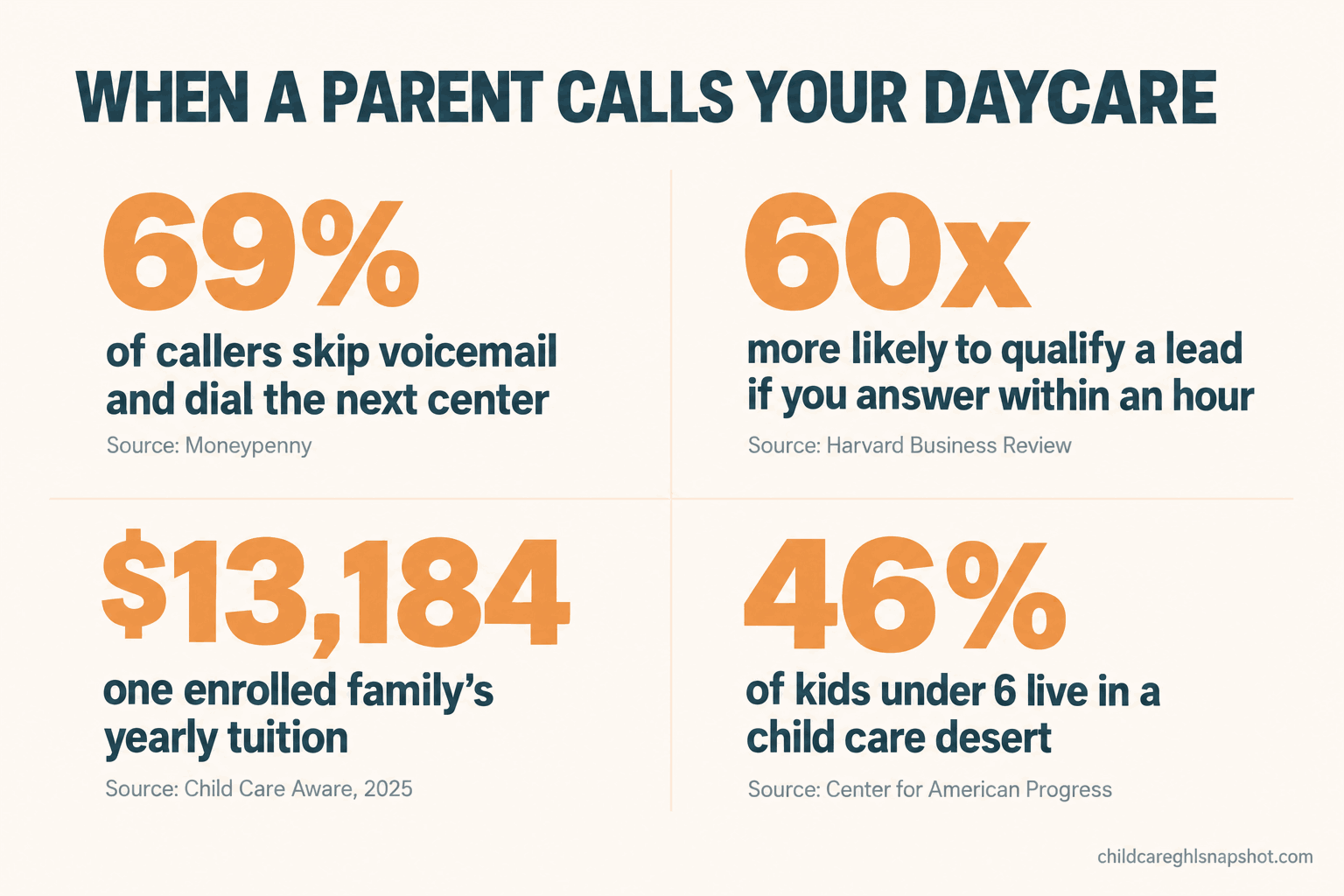
A parent calling you is already most of the way to buying. She found you, she picked up the phone, and she is ready to be told what to do next. If she gets voicemail instead, the odds turn fast: answering-service firm Moneypenny found 69% of callers who hit voicemail hang up without leaving a message and ring the next center. Speed research agrees, with Harvard Business Review finding firms that respond within an hour are about 60 times more likely to qualify a lead than firms that wait a day.
Put a number on it. The 2025 national average price of child care was $13,184 a year, per Child Care Aware of America. A family that enrolls an infant and stays two or three years is worth $26,000 to $40,000 before siblings and referrals. Demand is not the problem: with 46% of children under 6 in a licensed child care desert, per the Center for American Progress, seats are scarce. What you are short on is a reliable way to handle the call.
Lifetime tuition from one enrolled family at the 2025 national average of $13,184 a year (Child Care Aware of America). Roughly what rides on a single inquiry call.
The six parts of a daycare inquiry call
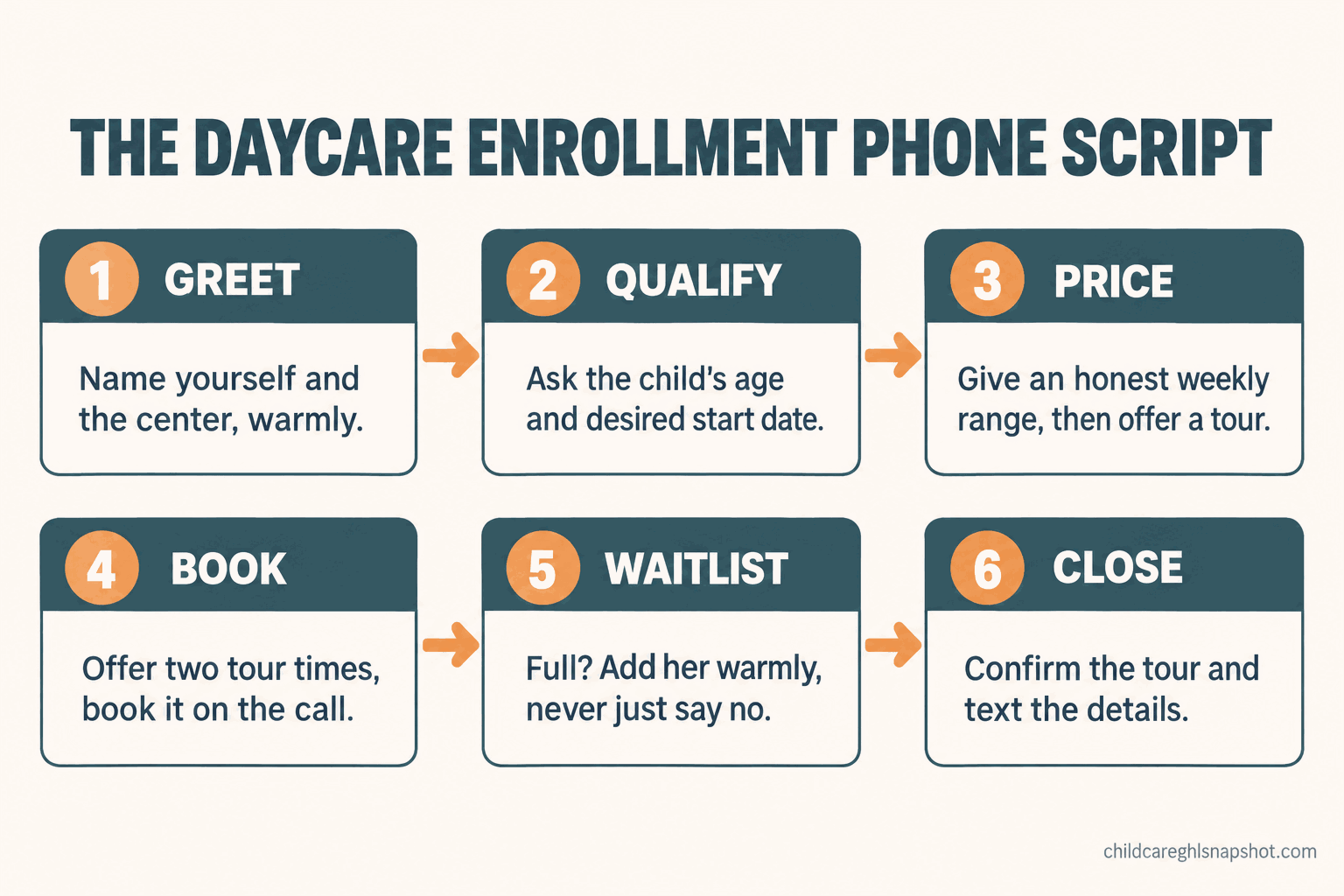
A good inquiry call is not a performance or a sales pitch. It is six short moves in a fixed order, and the order matters, because each move sets up the next and skipping ahead is what makes a call feel pushy. The arc: greet her, ask the two questions that tell you what she needs, handle the price question, book the tour while she is on the line, turn a full room into a waitlist instead of a goodbye, and close by telling her what happens next. Ninety seconds when you know the parts.
Part 1: The first ten seconds (your greeting)
How you answer sets the tone. “Little Sprouts, please hold” tells a nervous first-time mom she is an interruption. The greeting you want names the center, names you, and warmly invites her to talk in one breath (“Good morning, thanks for calling Little Sprouts, this is Colleen. Are you looking into care for your little one?”), so she knows she reached a real person who is glad she called. The exact wording for every move is in the copy-paste script below.
How this breaks: The cold corporate greeting (“how may I direct your call?”) makes a parent feel processed when she is already nervous. The other failure is the rushed greeting where the person is clearly mid-task, and the parent decides you are too busy for her. If you cannot give the call thirty focused seconds, better to let it roll to a system that texts her back fast.
Part 2: The two questions that tell you everything
Directors overcomplicate this. You do not need a ten-field intake, you need two answers: how old is the child, and when do they need to start. Age tells you the room, whether you are at ratio, and roughly the tuition. Start date tells you whether this is a “come Thursday” or a “save you a spot” conversation. Ask both in one line (“How old is your little one, and when were you hoping to start?”), then stop talking and let her answer. You learn more from her unprompted reply than from any form.
How this breaks: The over-qualifier turns a warm call into an interrogation, firing off immunization questions and policies before the parent has felt any warmth. Save that for the tour. The opposite failure is not listening: a mom who says “I already have my daughter with you” is a returning family, not a cold lead.
Part 3: The price question, answered without flinching
Somewhere in the first minute she asks what it costs. New directors either dodge (“it depends”) or blurt a scary annual number. Both lose her. Give an honest weekly or monthly range tied to the room, say what is included, then land on the tour question in the same breath, because price only makes sense once she has seen the place and a number left hanging scares her.
How this breaks: Dodging the price reads as hiding something, the same frustration parents feel with childcare software companies that make you sit through a demo just to learn the price, which I dug into in what childcare software actually costs in 2026. Quote a real range every time, and always follow the number with the tour question so a scary figure never hangs in the air.
Part 4: Book the tour on the call, not later
This is the most expensive mistake in the whole call. The parent is warm, and then someone says “think it over and call us back to set up a tour.” She means to. She does not. She gets busy, another center books her first, and your warm lead is gone. Book the tour now, by offering two specific times instead of an open-ended “when works for you.” Two choices (“Wednesday at 10 or Thursday at 4, which is easier?”) are far easier to answer than a blank calendar. Once she picks, lock it in and get her cell number for the confirmation.
How this breaks: The “call us back” handoff quietly kills more enrollments than any other line in daycare. Never put the next step on the parent’s to-do list when you can do it on the call. The second failure is booking the tour but not confirming it, so it evaporates by Thursday, which is the point of the playbook on cutting daycare tour no-shows.
Part 5: When you have no spot right now
Your infant room is full. The lazy answer, “sorry, we’re full, try us in a few months,” throws away a family worth more than $13,000 a year the moment a spot opens. A full room is not a rejection, it is a waitlist, and the parent who feels genuinely welcomed onto it is the one who says yes the day you call, not the one who already enrolled elsewhere. Tell her you do not want her to lose her place, take her info so you can call when a spot opens, and offer a tour now so she can decide fast when you do. That one move turns a dead end into a scheduled tour and a warm contact.
How this breaks: Treating the waitlist as a graveyard where names go and nothing happens. It only works if you nurture it with the occasional friendly update, its own system, covered in turning a daycare waitlist into enrollments. The other failure is not capturing her details, so you have a name and no number.
Part 6: The close, and what happens next
End by telling her what happens next, so she hangs up feeling organized. Confirm the tour time, confirm you will text the details, and leave her with one warm line. Then actually send that text before you hang up, because the follow-through proves your center is the organized, caring one.
How this breaks: The vague goodbye (“okay, great, see you soon”) leaves her unsure anything is booked, so always restate the day and time. The other failure is promising a text and not sending it, which tells her your follow-through is shaky at the exact moment she is deciding whether to trust you with her child.
Steal this: the full daycare phone script
Here is the whole thing in one block, plus the texts and voicemail scripts that back it up. Copy it, swap in your center name and tuition, and tape it by the phone.
The inquiry call, start to finish:
Greet: “Good morning, thanks for calling Little Sprouts, this is Colleen. Are you looking into care for your little one?”
Qualify: “Happy to help. How old is your little one, and when were you hoping to start?”
Price: “For her age our tuition runs about [X] to [Y] a week depending on full or part-time, and that includes [meals/diapers]. The best way to see if we’re the right fit is to come see the room. Would a tour this week work?”
Book: “I have Wednesday at 10 or Thursday at 4, which is easier? Perfect. What’s the best cell number to text you the details?”
Close: “I’ve got you down for Wednesday at 10. I’ll text our address and a photo of the room right now. We can’t wait to meet you and [child’s name]!”
If the room is full (the waitlist pivot):
“Our infant room is full right now, but I don’t want you to lose your place. Let me add you to the waitlist and take your info so I can call the moment a spot opens, usually around [month]. Would you like to tour now so you’re ready to decide fast when I call?”
The confirmation text (send before you hang up):
Hi [first name], it’s Colleen at Little Sprouts! You’re booked for a tour Wednesday at 10am. We’re at 412 Oak Street, park out front. Here’s a peek at the room: [photo]. Need a different time? Just reply here.
The waitlist voicemail (when you call with an opening):
Hi [first name], it’s Colleen at Little Sprouts with good news, a spot just opened in our infant room and you’re next on our list! Call or text me back and I’ll hold it for you. Talk soon!
The missed-call text-back (for when nobody could answer):
Hi, this is Little Sprouts, so sorry we missed you, we were with the children! Were you calling about enrollment? I can help right here by text. How old is your little one, and when were you hoping to start?
That last one matters because you cannot always pick up, and a parent who gets silence is gone. An instant text buys the time a live call would have, which is why centers pair the script with a missed-call text-back automation.
Run the script three ways
The six parts do not change, but who runs them does, depending on your size.
Solo operator, one site, 30 to 50 children. The call lands on you mid-floor. Tape the script by every phone and save the confirmation text as a template on your cell. You will miss calls, because you cannot answer while holding a two-year-old, so the missed-call text-back is not optional here, it is the only way you get first-response speed.
Mid-size, one or two sites, 60 to 100 children. You likely have an office person or assistant director, so the script becomes a training tool: walk everyone who answers through the six parts until booking on the call is automatic. The failure mode is the “I’ll pass your info to the director” handoff, where the inquiry dies waiting for a callback. Let whoever answers book the tour themselves.
Multi-site, three or more locations. Your risk is a parent calling about Site B and reaching Site A’s desk, who fumbles the handoff. Standardize the script, capture location first, and route each site’s calls to its own person. The location that answers badly is invisible until you measure it, so track who books tours on the call. The math on what each empty classroom costs makes the case for fixing the slow site.
The compliance part you cannot skip
The script leans on texting (the confirmation, the waitlist voicemail, the missed-call text-back), so run it legally. Getting it wrong is expensive and can silently stop your messages from sending.
The TCPA governs automated texts, with statutory damages of $500 per violating message and up to $1,500 for a willful one. What protects you: a text replying to a parent who just called you is operational and transactional, not marketing, so it sits on solid ground. Risk shows up when you blast promotional broadcasts to that number without consent. Second, A2P 10DLC is the registration every US business needs to text from a 10-digit number, handled through your provider and The Campaign Registry; skip it and carriers quietly block your texts.
Third, the childcare-specific rule. FERPA generally does not apply to private licensed daycares, so do not let anyone tell you it binds your marketing. What binds you is your state’s licensing rules on child-record confidentiality and photo consent: never name or show a specific child in marketing without consent on file, and that consent cannot be a condition of enrollment. The full breakdown is in texting daycare parents legally.
Objections I hear from directors
“A script will make me sound robotic.” It does the opposite. A script is not a teleprompter, it is a map so you never freeze or ramble. The parts become second nature in a week, and then you sound calm instead of scrambling. The robotic calls are the unscripted ones where someone is making it up.
“My staff won’t follow it.” They will if you make it the easy path: one laminated card by each phone, the confirmation text saved as a template, and ten minutes of practice at a staff meeting. People keep a script when it is the fastest way to end a call.
“What if I genuinely can’t pick up?” Then the call should roll to a system that texts the parent back in seconds, not a voicemail that 69% of callers abandon. The script is for the calls you take, the text-back for the ones you cannot. That full setup is the subject of why daycares lose enrollments to whoever calls back first, and if parents go quiet after the tour, this is how you win them back.
Your questions, answered
What do I say when a parent calls my daycare about enrollment?
Six moves in order: a warm greeting that names you and the center, two questions (the child's age and desired start date), an honest tuition range followed by a tour offer, booking the tour on the call with two specific times, a waitlist pivot if you are full, and a close that confirms the tour and promises a text. The full word-for-word script is above.
Should I tell parents the price on the phone?
Yes. Give an honest weekly or monthly range tied to the child's room, say what is included, then pivot straight to booking a tour. Dodging price makes parents feel you are hiding something, so never leave a number hanging without a next step.
How do I book the tour without sounding pushy?
Offer two specific times, not an open-ended question. 'Wednesday at 10 or Thursday at 4, which is easier?' is far easier to answer than 'when works for you?' Never end with 'call us back to schedule,' because that call rarely happens and a faster center books her first.
What should I say if my daycare is full?
Treat it as a waitlist, not a rejection. Tell her you don't want her to lose her place, capture her details so you can call when a spot opens, and offer a tour now. A full room today is a family worth over $13,000 a year the day a spot opens.
Is it legal to text a parent after an enrollment call?
Yes, done right. A text confirming a tour or sending your address to a parent who just called is operational and transactional, low risk under the TCPA. Register your number for A2P 10DLC or carriers block your texts, and never market a child's name or photo without written consent on file.
What if I can't answer the phone during the day?
Route missed calls to an automated text-back that fires within seconds, because about 69% of callers sent to voicemail hang up without a message and dial the next center. The script handles calls you take; the text-back handles the ones you can't.
So go back to that Monday at 8:50. Same mom, same nervous pause, but this time you are not winging it. You greet her, ask the two questions, give an honest range, and offer two tour times, and before she hangs up she has a Wednesday tour and a text with your address and a photo of the room. She made three calls that morning. Yours is the one she remembers, because it is the one where someone knew what they were doing.